Mayor-council government; fourteen ward councillors; a regional port and transit authority.
Explore city government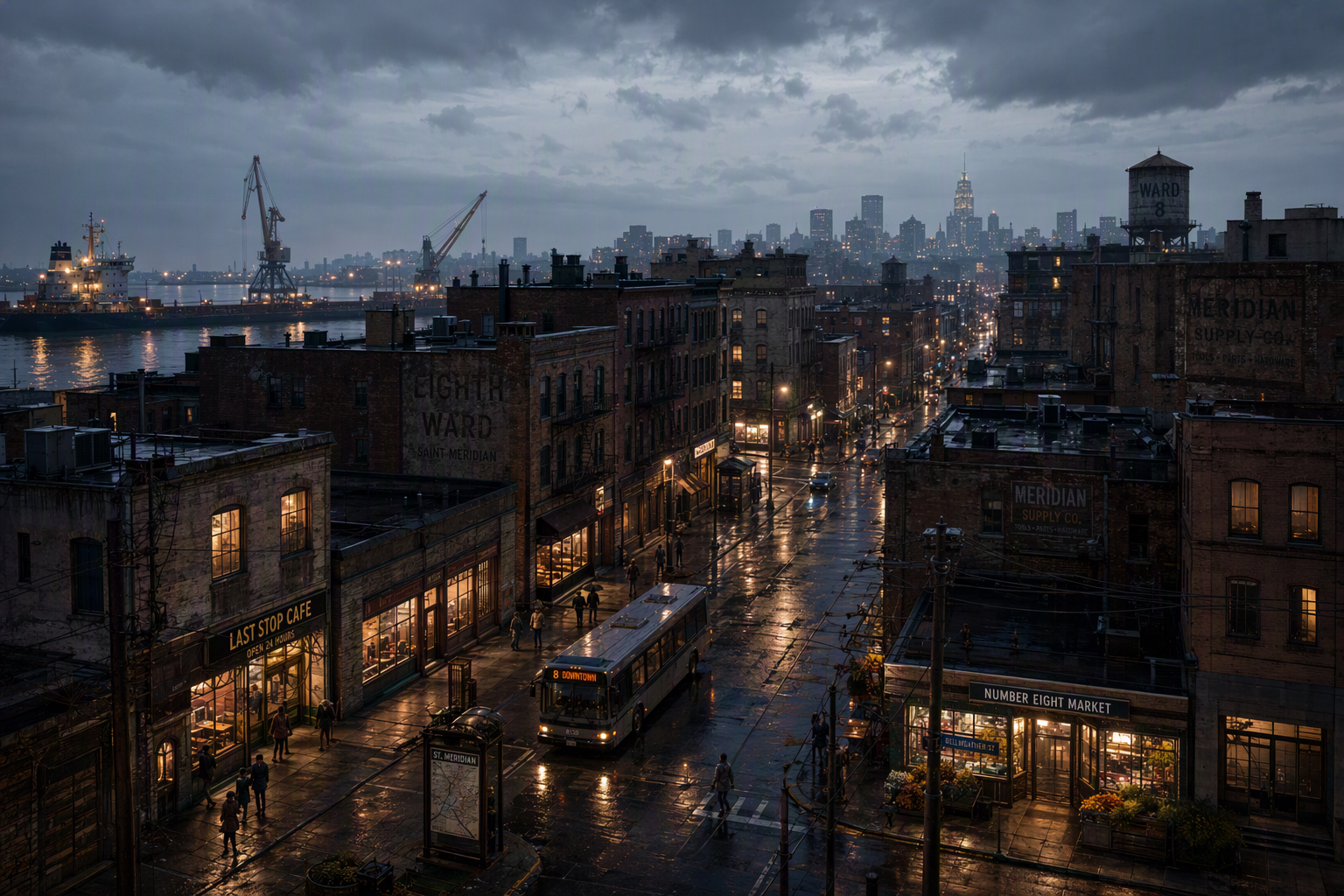
UC Studios · Flagship setting
Saint Morrow
Built on history. Haunted by what was buried.
A city with an imperfect memory
A working port city with a perfect address system and an imperfect memory.
Saint Morrow stands where the cold inland sea narrows into the Vey, a tidal river that carried timber, ore, grain, and generations of newcomers into the continent's interior. It is a real, functioning city: buses run late, hospitals overflow in winter, the waterfront is being redeveloped, and nobody agrees on the best pierogi. Its strangeness is not a second world hidden behind a magical door. It is the ordinary city behaving as if it remembers streets, people, and civic promises that official records insist never existed.
The north-eastern shore of Lake Huron, at the mouth of the fictional Vey River. Founded 1794, incorporated 1837.
- City residents
- 684,000
- Metro population
- 2.14 million
- Distinct districts
- 15
- First survey
- 1794
01 / Play
Adventures
Follow the clues, people, and places where the city's official story starts to come apart.
Explore adventures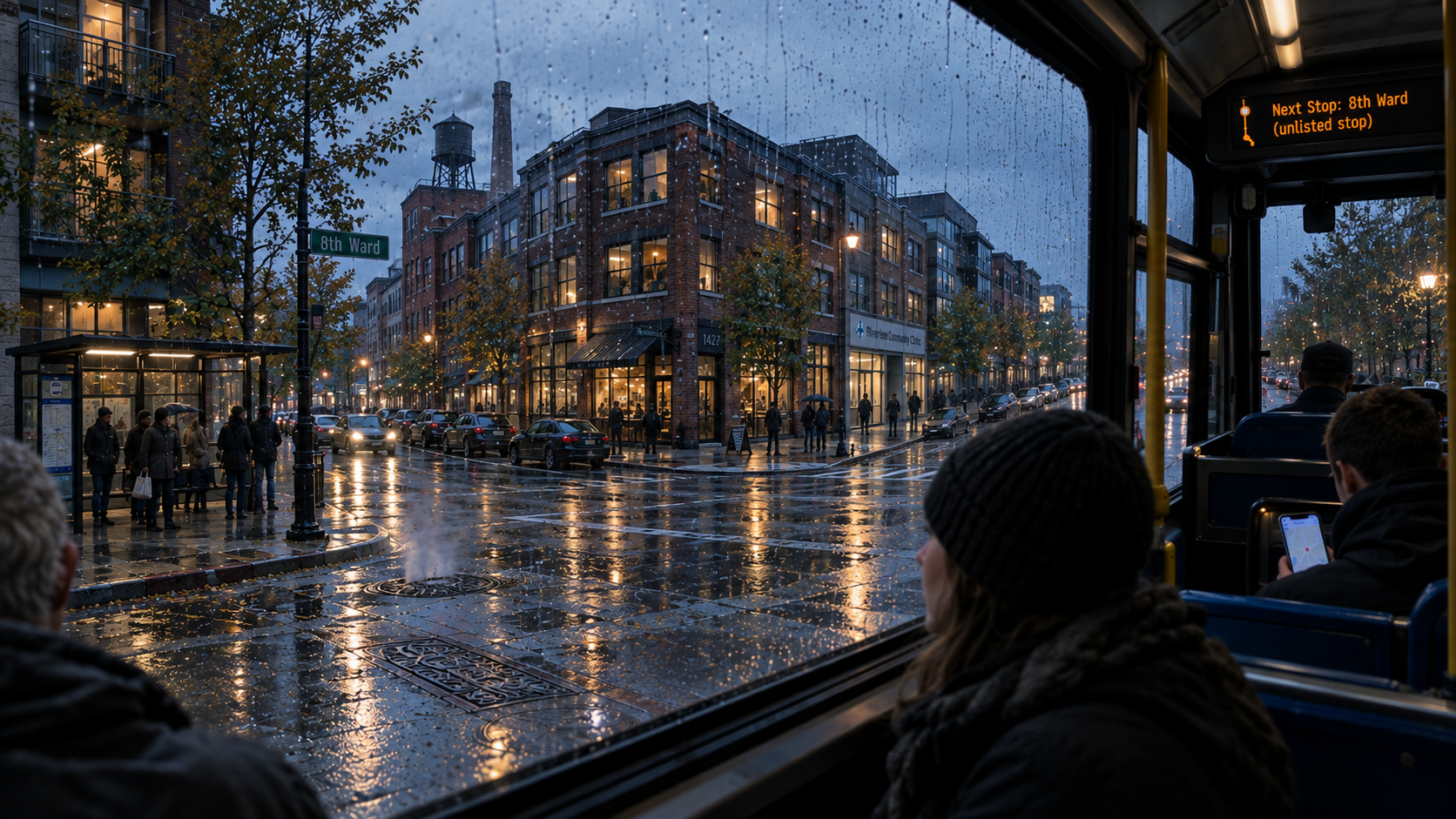 Case files · Saint Morrow
02 / Explore
Explore all locations Neighbourhoods
Explore the people, routines, and working places that give Saint Morrow its shape.
03 / Everyday life
City systems
Saint Morrow is a believable Great Lakes city before it is a supernatural one. Its ordinary systems are the machinery of the mystery.
A radial bus network, two light-rail lines, commuter rail, a working freight port, winter ferries, and an old streetcar tunnel sealed after the 1958 Meridian Works failure. The public map is accurate above grade and conspicuously vague below it.
Port logistics, health care, higher education, insurance, precision manufacturing, arts and hospitality, and a fast-growing heritage-remediation industry. The city is prosperous in aggregate and sharply unequal by block.
A legible cross-section of civic ambition: limestone warehouses, brick workers' terraces, art-deco offices, postwar concrete housing, glass infill, and lake-effect repairs. The city is not uniformly gothic; the unsettling buildings are usually the ones that look entirely ordinary.
Neighbourhood identity is stronger than city branding. Shift workers, students, old union families, new arrivals, and seasonal lake communities share public space without sharing one version of local history. The winter lantern walk is the closest thing Saint Morrow has to a civic ritual.
Meridian University, two community colleges, a respected public-school system, and the municipal Vey Archive. University special collections are excellent; their catalogue has unexplained gaps around four specific blocks.
Visible crime follows familiar pressures: housing insecurity, port theft, illicit demolition salvage, fraud, and political patronage. An unreported trade in anomalous addresses and recovered objects cuts across legitimate contractors, collectors, and a few public offices.
Influence moves through ward offices, union halls, hospital boards, neighbourhood associations, the port, university donors, and property consortia. Access matters more than lineage; a trusted building superintendent can know more than a city commissioner.
04 / The public record
History
Every public milestone leaves a seam: an address, a route, a worker, or a record that the official account cannot fit.
- Before 1600
The Vey estuary is a seasonal meeting and portage place for Indigenous communities. The land is not empty, and later municipal records will repeatedly pretend it was.
- 1794
Surveyor Elias Vale stakes a river customs post called Meridian House. His field book records a second river mouth that no later survey can locate.
- 1837
Saint Morrow incorporates after a timber boom. The charter names seven wards; an eighth ward appears in the clerk's copy, then is scraped away.
- 1872
The Bellweather fire destroys three blocks and the original land registry. Rebuilt streets shift by a few feet, leaving property boundaries that do not quite meet.
- 1911
Dockworkers excavating the East Switch rail cut uncover a tiled stair descending below the water table. The contractor fills it with concrete and bills the city for a drain.
- 1934
During a winter blackout, hundreds of residents report hearing a streetcar bell beneath the frozen river. The transit commission calls it a transformer fault.
- 1958
The Meridian Works project links transit, stormwater, and district heating tunnels. A section collapses without a sinkhole; 23 workers are listed as transferred, not missing.
- 1979
A municipal address-normalization program silently removes 418 residential addresses. Most are vacant lots. Eleven remain occupied and continue receiving mail.
- 2008
Flood-control works expose a dry, furnished apartment beneath the North Quay seawall. Its electric meter is still turning.
- 2025
A routine geospatial update generates a valid parcel number for the erased eighth ward. The number belongs to a building that appears only when a particular bus is delayed.
05 / 9 known sites
Buried sites
A layered record of homes, projects, routes, and public promises that were sealed instead of resolved.
Meridian Works
The 1958 connection between streetcar tunnels, storm drains, and district heat. The project is real; the official map ends at a concrete wall that has never been surveyed from both sides.
At the table: Service tunnel kits, maintenance crews, a route-selection challenge, and a deadline before the morning commute.The Dry Dock
A North Quay dock whose interior length exceeds its footprint. It contains fresh mooring marks, no vessel, and a tide table for a river that vanished from maps.
At the table: Vertical dock walls, gantries, a tug crew, and a retrieval encounter under rising water.The Quiet Platform
An unscheduled East Switch platform reached during a three-minute timetable gap. Its signs name destinations as personal memories rather than places.
At the table: Platform terrain, passenger witnesses, a moving train, and a choice of return ticket.The Warm Archive
A below-grade records room warmed by an obsolete district-heating main. Its files concern occupied homes that have no registered residents.
At the table: Archive shelving, document evidence, a custodian NPC, and a records-restoration Paint Vault set.Saint Oran's Lower Choir
A chamber below the cathedral containing no altar, only choir stalls turned toward a bricked doorway. The cathedral has never acknowledged the chamber's existence.
At the table: Stone stair and choir terrain, sound-led clues, and an encounter resolved by listening rather than combat.The Repeated Tenement
A Bellweather apartment building with seven street-facing windows and nine interior landings. Every landing belongs to a different year of the block's history.
At the table: Interchangeable stairwell floors, residents across time, and a rescue scenario with no stable initiative map.Vey Underways
A layered drainage and portage network below Silt Ward. Some channels are engineered; others predate the city's first survey and still follow the river's older course.
At the table: Flood markers, pump controls, skiff minis, route choices, and environmental threat tokens.The Unfiled Chapel
A small chapel built into a foundation beneath the Glass Mile. The names on its dedication wall belong to people listed in city payroll records as buildings.
At the table: A quiet investigation, removable name plates, a corporate archive link, and a moral rather than martial climax.The Blank Concourse
A tiled hall glimpsed in reflections across multiple stations. Each entrance is real; no two entrances open into the same version of the hall.
At the table: Modular concourse tiles, split-party rules, echoing announcements, and linked short adventures.06 / Anomaly register
Phenomena
Each phenomenon is bounded, investigable, and connected to ordinary people and systems.
Address Drift
A building's civic address changes by one digit for a single delivery, drawing a visitor to a place that has been demolished for decades.
The Third Bell
A bell rings from a structure with two bells. Witnesses agree on the time and disagree on which memory the sound brought back.
Borrowed Weather
A single street experiences tomorrow's weather for eleven minutes. Objects and people remain; the forecast does not.
The Unreturned Voice
A public-address system replies in the voice of a person who has never used that station, answering the question a listener has not yet asked.
Paper Tenant
A person appears only in the margins of forms and photographs. Their rent is current; their landlord cannot remember handing them the keys.
The Long Minute
A signal cycle lasts sixty seconds by the timer and long enough for a full conversation by everyone waiting to cross.
Salt Rain
A brief shower leaves crystalline salt on windows facing the old river course, even blocks inland and under clear skies.
The Repeated Caller
A disconnected landline rings at the exact time a different caller is reported missing. The voice asks for a street number, never a name.
Courtesy Floor
An elevator opens onto a clean, occupied floor omitted from the fire plan. The people there are polite and ask whether the meeting is still on.
The Civic Twin
Residents share a precise memory of a public building that cannot be found. Their versions disagree only about who paid for its demolition.
07 / Records, objects, and accounts
Evidence
Relics and artifacts
Objects keep complicated receipts.
Meridian House key
1794 customs postAn iron key whose teeth match no surviving lock. A wax impression of it opens a drawer in the 1911 East Switch survey cabinet.
The Warm Ledger
Meridian Works, 1958A cloth-bound maintenance ledger that stays warm at room temperature. Its final pages record the same crew on three different floors at once.
Ward Eight token
Transit fare issue, date disputedA brass fare token accepted by old turnstiles and rejected by every current fare reader. The stamped route number is not in the system.
Bellweather fire plate
1872 rebuilding surveyA small ceramic street-number plate found behind a modern shop wall. It bears a number officially assigned to a house that burned before numbering began.
The Third Bell clapper
Saint Oran's CathedralA bronze clapper removed during tower repairs. It makes a clear sound only in rooms from which someone has been erased from the record.
Vey glass negative
Vey Archive Trust collectionA photographic plate showing a crowded river crossing. Every later print has one more person than the negative's measured exposure could hold.
Urban legends
What people say to keep each other safe.
The last bus stops twice
If the East Switch night bus waits at a stop with no pole, do not ask the driver for the route. Tell the other passengers where you meant to go.
The story is a safety practice: report your intended destination to a witness before taking an unscheduled connection.The apartment with a second kitchen
A Bellweather building has one kitchen per unit on the plan and one extra kitchen behind the shared laundry wall.
The wall contains an old corridor. Its contents change, but the route is real and builders deserve the first warning.The market scale knows the date
At Ashmarket Hall, one scale gives the weight of an item on the day its owner will return for it.
The scale is a reliable prop for misdirection; one long-time vendor uses it to identify unclaimed goods and quietly find their owners.Never take the dry stair
During heavy rain, one Silt Ward stairwell stays dry and smells faintly of lake water. Residents say it descends to an older shoreline.
Following it can reach Vey Underways. The danger is flood timing, not a curse.The empty seat at the Lantern
The Lantern Theatre keeps one seat unsold even on a sold-out night. The usher says the seat belongs to the person who has not arrived yet.
There is no fixed ghost. The seat becomes a place to leave a note for someone the city has made hard to find.The city answers in receipts
Keep a receipt from a place that has closed. Some mornings the item list changes to show what the city took from you.
The changed receipts are found evidence. They can start an investigation but are not a supernatural verdict.Restricted knowledge
Some records need a custodian.
The names on the 1958 transfer list
Some listed workers were never missing; their families were told they had moved. Publish names only with consultation and a clear public-interest case.
The address normalization source file
It includes current tenants on parcels absent from the public database. Access creates a duty of care, not just a mystery clue.
The Blank Concourse return rule
The concourse will return a traveller to a remembered destination, not necessarily the one they entered from. A group should leave a route witness above ground.
08 / People and institutions
Factions
These institutions and coalitions disagree about what the city is, what it owes, and who gets to tell its history.
01 / FACTION
Municipal Continuity Office
Keep essential services reaching every occupied address; contain evidence only when disclosure would endanger residents.
Two connected rooms behind the Crownline records counter, listed as surplus storage.02 / FACTIONVey Archive Trust
Preserve provenance, return records to the communities that created them, and document absences as carefully as surviving documents.
A converted Bellweather bank branch, with a public reading room behind the former teller line.03 / FACTIONNight Maintenance Union, Local 81
Bring every worker home, keep routes inspectable, and stop departments from sending crews into spaces they refuse to map.
A union hall above a Calder Works tool library; the basement is not used for meetings.04 / FACTIONShoreline Compact
Protect working harbour livelihoods, public shoreline access, and the right of residents to know what moves through the port.
A second-floor room above North Quay Fish Hall, open whenever the market is.05 / FACTIONMeridian Redevelopment Authority
Consolidate parcels, accelerate construction, and keep liabilities attached to the city rather than project partners.
The authority's Glass Mile tower, with a model room one floor above the public board offices.06 / FACTIONThe Quiet Cartographers
Record the city's changing geometry without claiming to control it; publish safe routes and preserve contradictory measurements.
A borrowed table in the Meridian University geography lab every other Thursday.07 / FACTIONLantern Collective
Keep creative spaces open, document what happened without sensationalizing witnesses, and make sure artists are paid for their work.
A shared office and rehearsal room above the Lantern Theatre.08 / FACTIONMeridian University Field Group
Study anomalous civic records ethically, keep living participants in control of their testimony, and publish reproducible research.
A converted seminar wing beside the Vey Archive, with one room reserved for community review.09 / FACTIONThird Bell Society
Preserve rare material, protect the city's reputation, and decide who is qualified to interpret its past.
The former Bellweather Exchange Club, a narrow limestone mansion with an inaccessible third-floor archive.10 / FACTIONShorelight Clinic
Provide care without demanding proof of a person's place in the city; connect people to housing, records, and advocates.
A former pharmacy in Bellweather, with the entrance kept lit all night.Below the official map
The buried city is not a lost kingdom. It is a missing record.
Transit works, erased addresses, sealed rooms, and civic promises that never made it into the archive.
Open the case notes